
FEATURED NEWS
Beyond shade: UCLA researchers improve radiant cooling to make outdoor temperatures feel cooler
Approach uses low-cost, scalable, transparent and infrared-reflective surfaces and hydronic panels
By Christine Wei-li Lee and Matthew Chin
Key takeaways
- Active radiant cooling is a promising strategy for outdoor thermal comfort, but there are practicality and safety concerns with the typically opaque and dark structures that are needed.
- A team of UCLA engineers and researchers has tested a new design that lowered the mean radiant temperatures 10 degrees during field studies.
- The scalable design, which combines water-cooled aluminum panels and see-through, infrared-reflective thin polymer film, brings an additional level of cooling beyond shade to help people who have to be outdoors on hot days while preserving a sense of safe and open space.

This article was originally published by UCLA Newsroom
A team of UCLA engineers and researchers has developed a new technique to make it feel up to 10 degrees Fahrenheit cooler outside while preserving a sense of safe and open space.
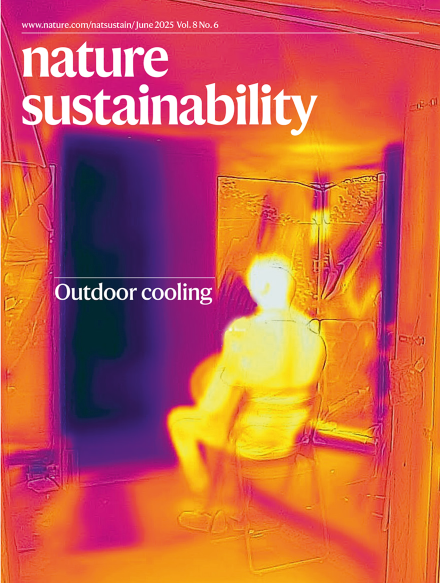
Recently featured as the June cover story in Nature Sustainability, the UCLA-led study demonstrated a new way to harness radiant cooling. Instead of relying on dark and windowless spaces, such as a tunnel, to create radiant cooling that raises safety concerns for public outdoor spaces, the new approach combines water-cooled aluminum panels and see-through, infrared-reflective thin polymer film, which allows both efficient cooling and visibility — a top priority, especially for residents in urban communities.
As climate change accelerates, extreme heat events are occurring with greater intensity and frequency, threatening the safety of people who spend significant time outdoors. Active radiant cooling, which uses surrounding surfaces such as cool roofs or floors to absorb heat from a space, has recently emerged as a promising strategy for outdoor thermal comfort, as it offers cooling at a distance without the inefficiency of conditioning unconfined air. However, for radiant cooling structures to be effective, the overwhelming majority of their internal surfaces must be actively cooled, typically with opaque panels, raising practicality and safety concerns. The UCLA team found a way to address these issues.
The research was funded by the National Science Foundation and the UCLA Sustainable LA Grand Challenge’s Heat Resilient LA project.
“This low-cost and scalable design is a practical step beyond shade to help people who have to be outdoors on hot days, especially during periods of extreme heat,” said study co-author Aaswath Raman,an associate professor of materials science and engineering at the UCLA Samueli School of Engineering who specializes in developing new materials and technologies to help lower temperatures. “This additional level of cooling can bring some relief in outdoor places where traditional air conditioning simply isn’t possible, such as metro stops, parks and plazas.”
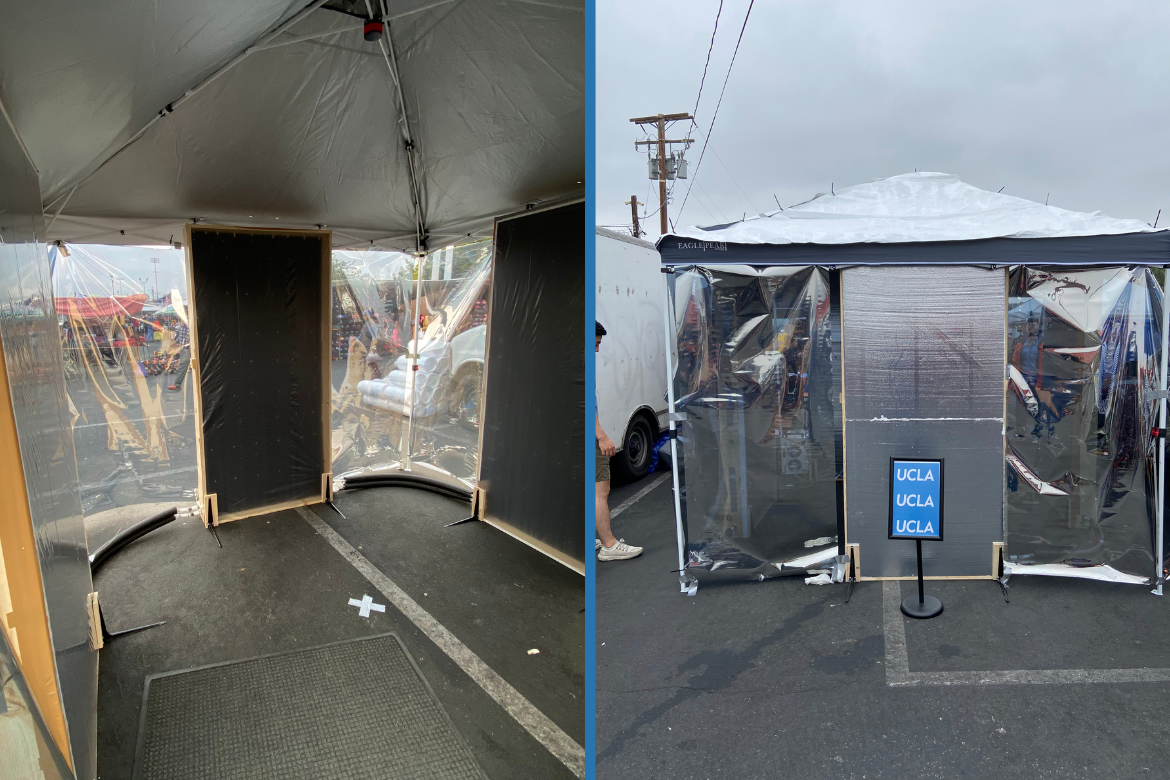
In field studies, the researchers conducted experiments on the UCLA campus and at the San Fernando Swap Meet on days when temperatures reached the mid-80s at each location. The team constructed a nearly 10-by-10-foot “tent,” comprising semi-transparent, infrared-reflective walls made of half-metallized thin polymer film; a roof built from radiative-cooling sheets; and three hydronic radiant-cooling panels made of aluminum sheets with cold water flowing behind them to keep the panels actively cool. To enhance cooling efficiency, the team also painted the inward-facing side of the panels black to absorb incidental heat, such as body heat from people within the structure. The semi-transparent walls allow occupants to see outside without visual obstruction.
The researchers found that their structure had a mean radiant temperature of about 78 degrees Fahrenheit. This was not only lower than the ambient air temperature of approximately 84 degrees but also more than 10 degrees cooler than the mean radiant temperature of about 90 degrees that a person would have otherwise experienced due to heat radiating from surrounding surfaces. The team also surveyed participants who stood in the cooling structure, with most reporting feeling cooler and more comfortable than they would in shade alone.
“Radiant temperature” refers to a commonly experienced phenomenon: when a person’s perceived temperature differs from the actual air temperature. For example, when someone walks from an asphalt-paved parking lot to a grassy area, then to a space under a tree, the air temperature stays the same, but it feels cooler because the grass and shade shield the person from heat radiated by surrounding surfaces, such as asphalt. This effect helped inspire the researchers’ new approach to tackling heat.
“Cities need to think about shade as infrastructure,” said study co-author V. Kelly Turner, a UCLA associate professor of urban planning and geography and associate director of the Luskin Center for Innovation who studies heat equity. “This accessible design can help patch in where there is not enough shade for people to be comfortable outdoors on hot days.”
The paper’s lead author is David Abraham, a doctoral student in Raman’s research group at UCLA Samueli. Other authors include Dr. Mackensie Yore, an emergency medicine physician at UCLA Health; Kirsten Schwarz, an associate professor of urban planning at the UCLA Luskin School of Public Affairs and of environmental health sciences at the UCLA Fielding School of Public Health; Dr. David Eisenman, a professor-in-residence at the David Geffen School of Medicine at UCLA with a joint appointment at Fielding School; and Walker Wells, an urban planning lecturer at the Luskin School. Other authors from Raman’s group are undergraduate student Robert Yang, former graduate student Xin Huang and former postdoctoral scholar Jyotirmoy Mandal.