
FEATURED NEWS
Q&A With Dr. Ikechukwu “Ike” Okorafor
By Nicole Wilkins
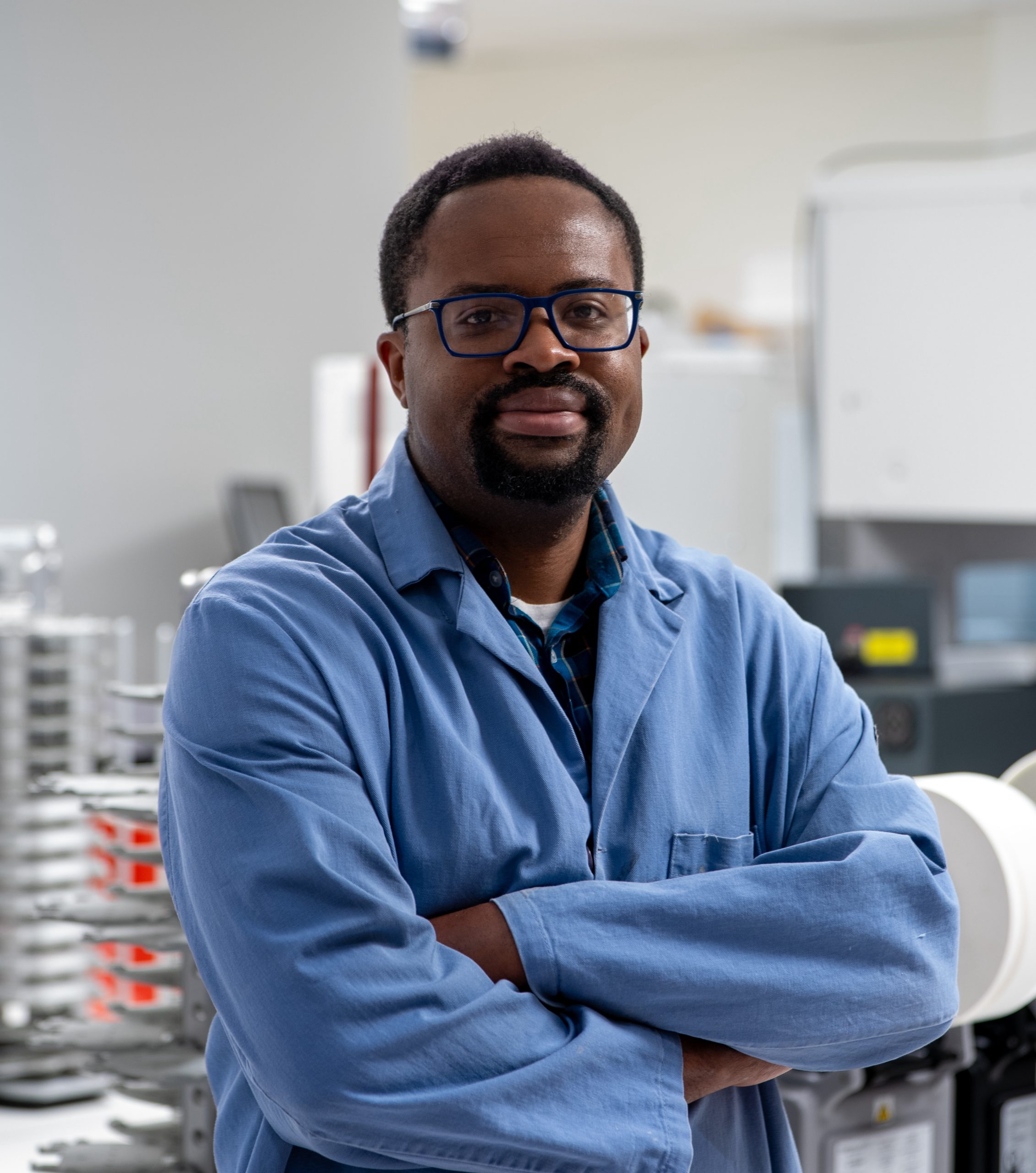
Ike Okorafor is an Associate Project Scientist for the MIP Living BioFoundry at the California NanoSystems Institute at UCLA.
Okorafor received his doctorate in Chemical Engineering from the UCLA Samueli School of Engineering in 2023. He conducted his doctoral research in the Yi Tang lab, in the department of Chemical and Biomolecular Engineering, focusing on developing a novel olivetolic acid platform for the further study of the therapeutic/pharmacological effects of cannabinoids.
We recently sat down with Ike to learn more about his research and career path as a scientist.
Q: Tell us a little bit about yourself and what brought you to UCLA
A: I was born in Newark, New Jersey and raised in Irvington, New Jersey. I am a middle child, having an older brother and younger sister. I studied chemical engineering at Stanford University, did a Masters in the same subject at Columbia University, and worked in Boston at a genome engineering startup called enEvolv for 2.5 years before I decided to do my PhD. I came to UCLA to do my PhD in chemical engineering under Professor Yi Tang working on fungal natural product biosynthesis. I liked the work being done in the Tang Lab and wanted to check out Los Angeles so it was a win-win in my mind. During my time in my PhD, I became a BioPacific MIP fellow and did part of my research working in the Living BioFoundry where I got to know many of the people I am now working with.
Q: How did you get interested in science in general and nanotechnology in particular?
A: Ever since I was kid, I was always interested in how things operated. Whether that was through dissembling pens and trying to build them together, doing the same with electrical devices, watching Bill Nye the science guy, etc. I wanted to know how things work. Participating in and attending science fairs also played a role in my interest in science. Furthermore, my dad was also a big influence. He’s a professor of chemical engineering and from an early age, tried to show my siblings and I how interesting and diverse the field was, and he succeeded in doing so. It was through my studies in chemical engineering in undergrad that I got into nanotechnology and realized how applicable it was in many fields, from energy and environment to electronics and computing to the food industry to medicine and healthcare, etc.
Q: Why is nanoscience interesting to you?
A: To me, it’s fascinating how innovative and impactful discoveries can be made at such a small scale. One good example is targeted drug delivery, finding ways to deliver drugs into the body utilizing nanoparticles. This has become an emerging field, which applications to try to treat diseases like Alzheimer’s and cancer. Nanoscience has also emerged as a key field in developing sustainable energy solutions and more eco-friendly and efficient manufacturing processes. The field is so vast and offers potential to solve a lot of key challenges which is exciting. I also appreciate the interdisciplinary nature of nanoscience, where I can collaborate with engineers, chemists, physicists, biologists, etc.
Q: What equipment do you use to conduct your work or research, and how does it work?

A: I currently work in the Living BioFoundry in Rm 2145. The Living BioFoundry is a automated, high-throughput platform for synthetic biology, capable of performing many functions including gene assembly, amplification, transformation, strain growth, and metabolite analysis. We are basically translating everything from the bench scale to a high-throughput automated scale. I may be getting too deep in the details, but we use a Tecan Liquid Handler which uses a robot arm for automated pipetting utilizing 8 tips at a time and an additional robot arm that moves plates, tips, boxes, etc. from one place on the deck to another. The Tecan platform also has an automated plate colony picker and a Bioshake which functions as a vortexer. We also have a ThermoFisher Laboratory Automation System (LAS), consisting of 2 polymerase chain reaction (PCR) machines, an incubator, plate reader, centrifuge, plate sealer and peeler, barcode scanner, and plate washer. PCR is a method used to amplify DNA. This automated platform really allows us to scale up our experiments and test hundreds of combinations of enzymes, strains, metabolites, etc. simultaneously, allowing us to answer our hypotheses much quicker. As an example, we have 2 PCR machines capable of handling 96-well plates, meaning theoretically, we can do 192 PCRs in the same amount of time it takes to do just 1 PCR. We also have an electroporator capable of transforming 96 DNA constructs at a time. An electroporator is used to transform DNA into bacteria, yeast, fungi, mammalian cells, etc. It works by applying a high-voltage electric field to the cells which makes the cell membrane more permeable, creating an opening where the DNA can enter. We also use an ultra high-performance liquid chromatography (UHPLC) that is connected to a triple quadrupole mass spectrometer (TQ-MS). The UHPLC-TQMS is a powerful analytical device that we use to analyze and quantify the compounds that we are producing.
Q: What have you learned from your research experiences so far?
A: I’ve learned so much. My PhD research focused on developing a novel olivetolic acid production platform for the further study of the therapeutic/pharmacological effects of cannabinoids, so I’ve learned a lot about biosynthesis, cannabinoids, and synthetic biology. Bigger picture wise, from my research experiences, I’ve learned the importance of perseverance in research, how to better collaborate with others, and how to write grants and publish in peer-reviewed publications. I’ve also learned the importance of designing the right experiments to answer your hypothesis, to not get discouraged, and the importance of networking.
Q: What advice (or words of encouragement) would you give Black or underrepresented students interested in studying STEM or pursuing STEM as a career?
A: I would say this is a worthwhile career and to pursue it. You can definitely make a positive impact on the world, solving key issues. Perseverance is key in STEM. It’s not easy. So many of my experiments have failed and it can be easy to get discouraged after seeing barely any success for a while but it’s important to keep trying and to never lose your confidence. An experiment with a negative result is still an answer to your hypothesis. A failed exam does not mean that you’re not cut out for this. Don’t limit yourself. Seek out mentorship and don’t be afraid to reach out for help. Others have gone before you and can give you the advice, help, connections that you need to succeed. Don’t be afraid to make mistakes. Ask as many questions as you can. Join organizations like National Society of Black Engineers (NSBE) where you’re with like-minded people, look at your school’s alumni on Linkedin/email lists and reach out to them for advice/career leads. You can definitely succeed in STEM.
Q: Anything else you would like to add or share about yourself or your work?
A: Nothing else really, but if anyone, especially undergraduates, who is interested in this type of work has any more questions to ask, please feel free to reach me at iokorafor@cnsi.ucla.edu. I would love to talk more and answer any questions you may have.
Ike Okorafor is an Associate Project Scientist for the MIP Living BioFoundry at the California NanoSystems Institute at UCLA.
Okorafor received his doctorate in Chemical Engineering from the UCLA Samueli School of Engineering in 2023. He conducted his doctoral research in the Yi Tang lab, in the department of Chemical and Biomolecular Engineering, focusing on developing a novel olivetolic acid platform for the further study of the therapeutic/pharmacological effects of cannabinoids.
We recently sat down with Ike to learn more about his research and career path as a scientist.
Q: Tell us a little bit about yourself and what brought you to UCLA
A: I was born in Newark, New Jersey and raised in Irvington, New Jersey. I am a middle child, having an older brother and younger sister. I studied chemical engineering at Stanford University, did a Masters in the same subject at Columbia University, and worked in Boston at a genome engineering startup called enEvolv for 2.5 years before I decided to do my PhD. I came to UCLA to do my PhD in chemical engineering under Professor Yi Tang working on fungal natural product biosynthesis. I liked the work being done in the Tang Lab and wanted to check out Los Angeles so it was a win-win in my mind. During my time in my PhD, I became a BioPacific MIP fellow and did part of my research working in the Living BioFoundry where I got to know many of the people I am now working with.
Q: How did you get interested in science in general and nanotechnology in particular?
A: Ever since I was kid, I was always interested in how things operated. Whether that was through dissembling pens and trying to build them together, doing the same with electrical devices, watching Bill Nye the science guy, etc. I wanted to know how things work. Participating in and attending science fairs also played a role in my interest in science. Furthermore, my dad was also a big influence. He’s a professor of chemical engineering and from an early age, tried to show my siblings and I how interesting and diverse the field was, and he succeeded in doing so. It was through my studies in chemical engineering in undergrad that I got into nanotechnology and realized how applicable it was in many fields, from energy and environment to electronics and computing to the food industry to medicine and healthcare, etc.
Q: Why is nanoscience interesting to you?
A: To me, it’s fascinating how innovative and impactful discoveries can be made at such a small scale. One good example is targeted drug delivery, finding ways to deliver drugs into the body utilizing nanoparticles. This has become an emerging field, which applications to try to treat diseases like Alzheimer’s and cancer. Nanoscience has also emerged as a key field in developing sustainable energy solutions and more eco-friendly and efficient manufacturing processes. The field is so vast and offers potential to solve a lot of key challenges which is exciting. I also appreciate the interdisciplinary nature of nanoscience, where I can collaborate with engineers, chemists, physicists, biologists, etc.
Q: What equipment do you use to conduct your work or research, and how does it work?
A: I currently work in the Living BioFoundry in Rm 2145. The Living BioFoundry is a automated, high-throughput platform for synthetic biology, capable of performing many functions including gene assembly, amplification, transformation, strain growth, and metabolite analysis. We are basically translating everything from the bench scale to a high-throughput automated scale. I may be getting too deep in the details, but we use a Tecan Liquid Handler which uses a robot arm for automated pipetting utilizing 8 tips at a time and an additional robot arm that moves plates, tips, boxes, etc. from one place on the deck to another. The Tecan platform also has an automated plate colony picker and a Bioshake which functions as a vortexer. We also have a ThermoFisher Laboratory Automation System (LAS), consisting of 2 polymerase chain reaction (PCR) machines, an incubator, plate reader, centrifuge, plate sealer and peeler, barcode scanner, and plate washer. PCR is a method used to amplify DNA. This automated platform really allows us to scale up our experiments and test hundreds of combinations of enzymes, strains, metabolites, etc. simultaneously, allowing us to answer our hypotheses much quicker. As an example, we have 2 PCR machines capable of handling 96-well plates, meaning theoretically, we can do 192 PCRs in the same amount of time it takes to do just 1 PCR. We also have an electroporator capable of transforming 96 DNA constructs at a time. An electroporator is used to transform DNA into bacteria, yeast, fungi, mammalian cells, etc. It works by applying a high-voltage electric field to the cells which makes the cell membrane more permeable, creating an opening where the DNA can enter. We also use an ultra high-performance liquid chromatography (UHPLC) that is connected to a triple quadrupole mass spectrometer (TQ-MS). The UHPLC-TQMS is a powerful analytical device that we use to analyze and quantify the compounds that we are producing.
Q: What have you learned from your research experiences so far?
A: I’ve learned so much. My PhD research focused on developing a novel olivetolic acid production platform for the further study of the therapeutic/pharmacological effects of cannabinoids, so I’ve learned a lot about biosynthesis, cannabinoids, and synthetic biology. Bigger picture wise, from my research experiences, I’ve learned the importance of perseverance in research, how to better collaborate with others, and how to write grants and publish in peer-reviewed publications. I’ve also learned the importance of designing the right experiments to answer your hypothesis, to not get discouraged, and the importance of networking.
Q: What advice (or words of encouragement) would you give Black or underrepresented students interested in studying STEM or pursuing STEM as a career?
A: I would say this is a worthwhile career and to pursue it. You can definitely make a positive impact on the world, solving key issues. Perseverance is key in STEM. It’s not easy. So many of my experiments have failed and it can be easy to get discouraged after seeing barely any success for a while but it’s important to keep trying and to never lose your confidence. An experiment with a negative result is still an answer to your hypothesis. A failed exam does not mean that you’re not cut out for this. Don’t limit yourself. Seek out mentorship and don’t be afraid to reach out for help. Others have gone before you and can give you the advice, help, connections that you need to succeed. Don’t be afraid to make mistakes. Ask as many questions as you can. Join organizations like National Society of Black Engineers (NSBE) where you’re with like-minded people, look at your school’s alumni on Linkedin/email lists and reach out to them for advice/career leads. You can definitely succeed in STEM.
Q: Anything else you would like to add or share about yourself or your work?
A: Nothing else really, but if anyone, especially undergraduates, who is interested in this type of work has any more questions to ask, please feel free to reach me at iokorafor@cnsi.ucla.edu. I would love to talk more and answer any questions you may have.